The establishment of the Weimar Republic was based on a political compromise to protect the German population against the consequences of its loss in World War I. The republic was therefore also referred to as the “improvised democracy” or the “democracy without democrats.”
As military defeat become impossible to deny in October of 1918, the German Empire plunged into a domestic political crisis. Policy makers gave in to the United States demands for a ceasefire, complete military surrender, and the resignation of the Kaiser. However, these changes unfolded gradually and at the same time a revolutionary movement emerged in Germany. Insurgencies among sailors erupted in Wilhelmshaven and Kiel and spread throughout the nation within days. Workers and military councils were established that issued political demands, including the creation of a democratic republic. The proclamation of the Free State of Bavaria by Kurt Eisner on the night between the 7th and 8th of October were the first steps toward a republic.
The revolutionary movement reached Berlin on November 9, 1918. In the face of mass protests, the Reich Chancellor Max von Baden declared the Kaiser's resignation, without prior authorization, and handed over his office to Friedrich Ebert, head of the German Social Democratic Party (SPD). To Ebert's complete surprise, his party comrade Philipp Scheidemann proclaimed the Republic from the balcony of the Reichstag. Only shortly afterwards Karl Liebknecht proclaimed the Free Socialist Republic at the Berliner Stadtschloss (Berlin City Palace). From day one, the Republic was marked by a power struggle between Social Democrats, the Centre Party and the Liberal Left on the one hand and the Revolutionary Left on the other. The latter included prominently the Spartacist League (Spartacusbund) under the leadership of Rosa Luxemburg and Karl Liebknecht whose members rejected parlamentarianism and advocatde for a council republic. This power struggle culminated in the so-called Spartacist Uprising (Spartakusaufstand) in January of 1919 that was violently defeated by the military. Among the hundreds of people murdered were Rosa Luxemburg and Karl Liebknecht.
This event was in many ways a call to arms for the German working class, who felt betrayed by the SPD-led government. Strikes and riots occurred with increasing frequency and were put down by the government forces. Among the bloodiest was the attempted coup d'état by the Spartacists which took the lives of more than 1,200 people.
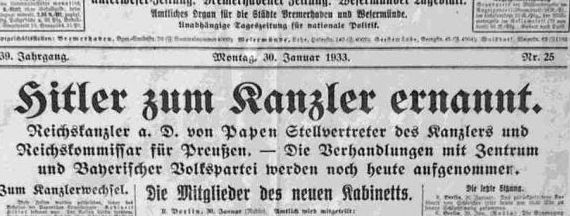
In the early 1930s this political instability and violence, economic problems, unemployment, and growing antisemitism create a political climate that enables the rise of the right-wing NSDAP. In the parliamentary elections for the Reichstag in September of 1930, they gain more than 18 percent of the vote, during the 1931 elections even more than 37 percent of the vote. As a consequence Paul von Hindenburg, President of the Reich at the time, appoints Adolf Hitler as Reich Chancellor at the end of January 1933. This also marks the end of Germany's only fifteen-year-old first democracy and the beginning of the national socialist dictatorship (Appointment of Hitler as Reich Chancellor, 1933).




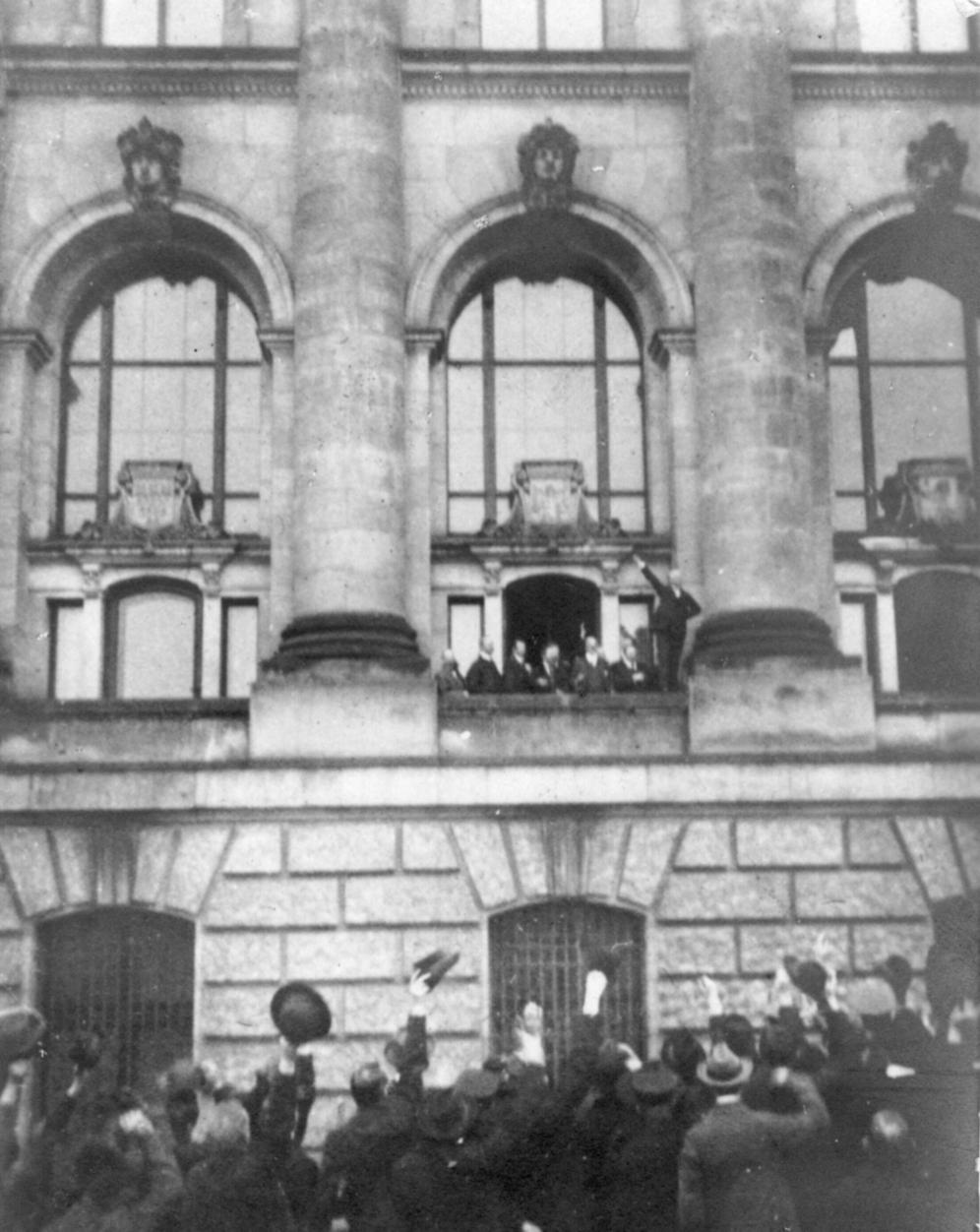 Berliner Illustrierte Zeitung vom 24.11.1918, Nr. 47