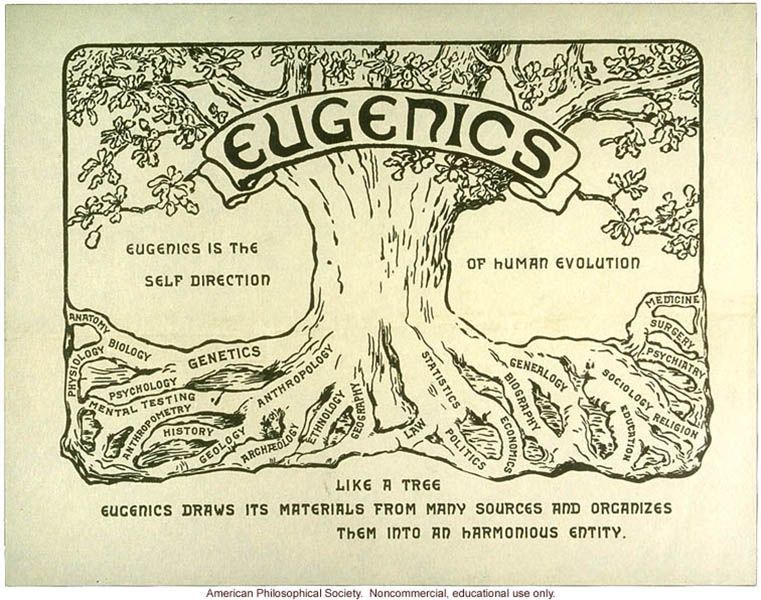
The theories of naturalist Charles Darwin influenced not only various branches of science, but also the political ideologies of the time. Under National Socialism, social Darwinist arguments were used to scientifically legitimize “racial hygiene.”
In 1859, naturalist Charles Darwin published his magnum opus, On the Origin of Species by Means of Natural Selection, or the Preservation of Favoured Races in the Struggle for Life. In it, he put forward the theory of natural selection, according to which only those beings that are best able to assert themselves in the struggle for existence can reproduce and survive. Initially, this only referred to the animal and plant kingdoms. Later, however, he wrote about the “elimination of the weak” in relation to humans. According to this theory, humans, due to their acquired instinct of compassion, are no longer able to adequately select the so-called weak (meaning primarily sick people and people with disabilities). This, he argued, puts the future of humanity at risk.
Darwin's theory of natural selection quickly found its way into various sciences, where it was used to explain the development of human societies. This was accompanied by the idea that humans naturally always strive for a “higher stage of development” and that there is ‘good’ (superior) and “bad” (inferior) genetic material. Since its inception, social Darwinism has therefore been closely linked to political ideologies that represent racist and imperialist viewpoints. Among other things, it serves to legitimize German colonialism and forms the supposedly scientific basis for eugenics and National Socialist “racial hygiene.”
In June 1905, a group of scientists founded the Society for Racial Hygiene in Berlin. Among the first members were physician Alfred Ploetz, psychiatrist Ernst Rüdin, writer Gerhart Hauptmann, and eugenicist Max von Gruber. Zoologist Ernst Haeckel became an honorary member. They made it their mission to research the laws of human heredity and recommend measures for a “racially” hygienic lifestyle. In 1915, the society cooperated with the German Society for Population Policy for the first time. After the NSDAP came to power, the Society for “Racial Hygiene” became part of the political apparatus and influenced racist legislation, such as the “Law for the Prevention of Hereditary Diseases” (see Hitler becomes Reich Chancellor, 1933). Social Darwinist and eugenic assumptions were thus used to legitimize marriage bans, human experimentation, forced sterilizations, and ultimately the Nazi mass murders.